
"The algorithm developed by Dribia quickly indicates the appropriate adjustments of the mills to ensure a good milling process. It allows us to accelerate the initial adjustment process and support millers in decision-making."
FEATURES
Optimization of mill adjustments to maximize the yield of transformation of wheat into flour.
IMPACT
The algorithm generates an immediate adjustment proposal that, integrated into the factory’s MES system, guides millers in the mill adjustment process.
ACHIEVEMENTS
It speeds up the adjustment of the entire set of mills and provides a prediction of the expected yield of the batch, with errors less than 5%.
BUSINESS PROBLEM
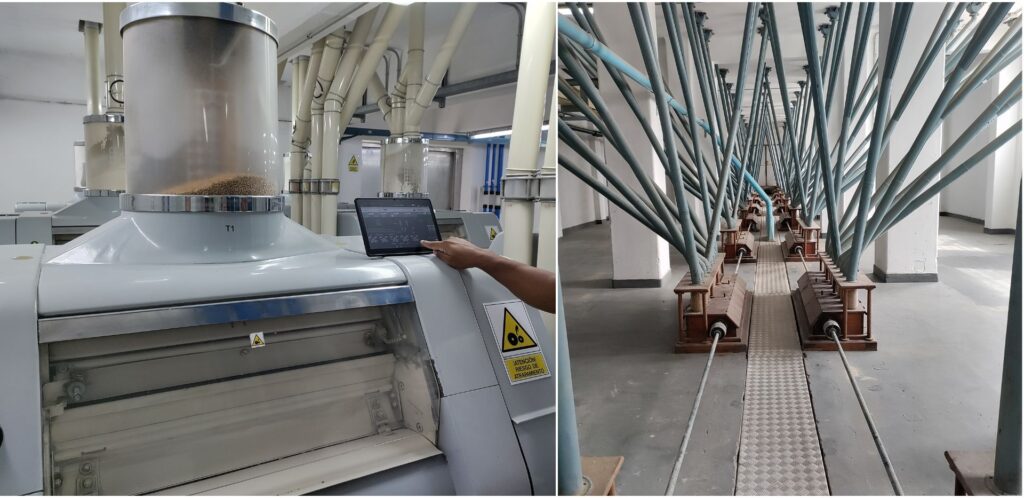
In the process of transforming wheat into flour, a key indicator is the transformation yield, which is the ratio of wheat vs. rye that is obtained as a result of milling. It is desirable to achieve maximum yield without compromising the quality of the resulting flour. To achieve this balance, the milling manager must adjust, according to his experience and the particular characteristics of the wheat that has to be ground, each of the mills (around 20) in the factory. This is a manual process, guided by the operator’s experience and difficult to protocolize.
DRIBIA’S SOLUTION
Led by the Clúster Digital de Catalunya and with the support of companies such as Farinera Coromina and AETECH, Norman applies predictive algorithms to optimize the process of transforming wheat into flour. Through models that connect the characteristics of the grain with the operational parameters, it is possible to adjust variables in real time, ensuring optimal use of resources.
We have developed an algorithm that, based on data such as: the type of wheat and the results of laboratory analysis of the wheat; proposes the optimal adjustments of the mills and the expected energy consumption for each motor. The system uses a Bayesian optimization algorithm to find the best configuration among the more than 20 motors that drive the mill system in less than two minutes. The solution proposed by the algorithm provides direct indications to millers of the adjustment that must be applied to each mill in order to achieve the best performance in transforming wheat into flour while preserving the quality of the final product.
The impact of the Norman project, funded within the framework of the AEI 2024 call, extends beyond flour production. This initiative transforms not only the milling process but also the entire agri-food value chain, demonstrating the potential of technology to combine operational efficiency and respect for the environment.